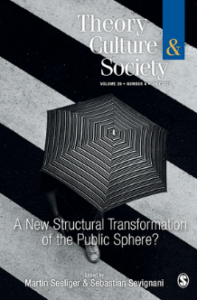
 In Theory, Culture & Society ist mein gemeinsam mit Philipp Staab geschriebener Aufsatz „Social Media and the Digital Structural Transformation of the Public Sphere“ erschienen. Wir fragen, wie sich mit Habermas’ Theorie des Strukturwandels der Öffentlichkeit über soziale Medien nachdenken lässt und wo die Theorie angesichts der digitalen Konstellation einer Überarbeitung bedarf. Im Mittelpunkt steht ein Spannungsverhältnis: Soziale Medien können Menschen politisch aktivieren, aber die Bedingungen dafür bestimmen wesentlich die kommerziellen Interessen der Plattformbetreiber.
Unser Artikel ist in ausgesprochen guter Gesellschaft. Das Themenheft „A New Structural Transformation of the Public Sphere?“ enthält Jürgen Habermas’ Überlegungen zur Aktualisierung seiner Öffentlichkeitstheorie, ein Interview mit Judith Butler und Beiträge unter anderem von Hartmut Rosa, Silke van Dyk und Donatella della Porta. Mein herzlicher Dank gilt Martin Seeliger und Sebastian Sevignani. Sie hatten bereits den deutschsprachigen Leviathan-Sonderband konzipiert, für den Philipp und ich „Privatisierung ohne Privatismus“ geschrieben haben.
Bibliografischer Nachweis: Philipp Staab und Thorsten Thiel (2022). Social Media and the Digital Structural Transformation of the Public Sphere. Theory, Culture & Society 39 (4), 129–143. DOI · Open-Access-Fassung an der Humboldt-Universität zu Berlin.
Abstract
This article explores the question of how to understand social media following the Habermasian theory of the structural transformation of the public sphere. We argue for a return to political-economic fundamentals as the basis for analysing the public sphere and seek to establish a characteristic connection between digital-behavioural control and singularised audiences in the context of proprietary markets. In the digital constellation, it is less a matter of immobilising the citizen as a consumer but rather of their political activation – albeit in conditions under which commercial interests have primacy: privatisation without privatism.